
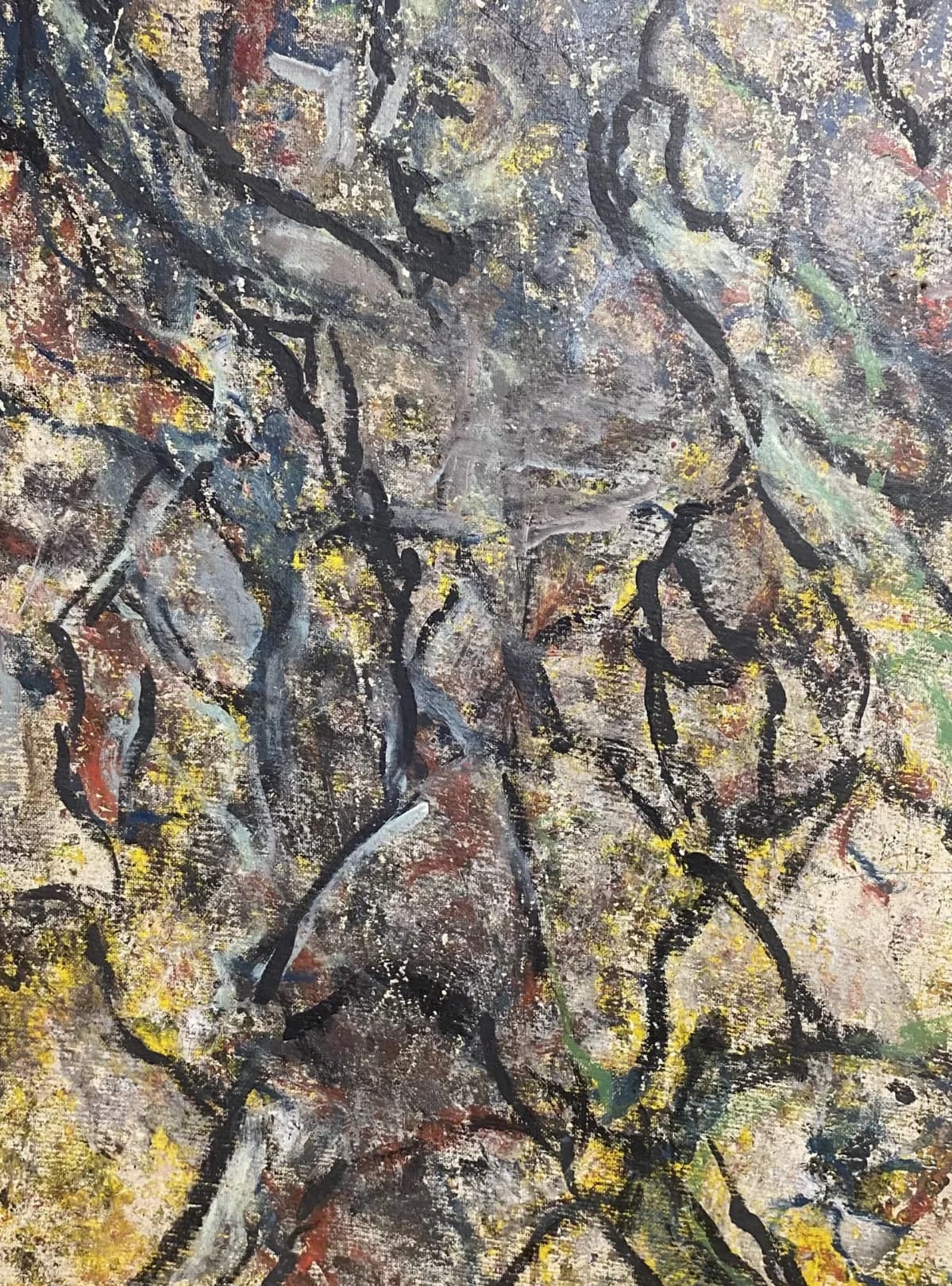
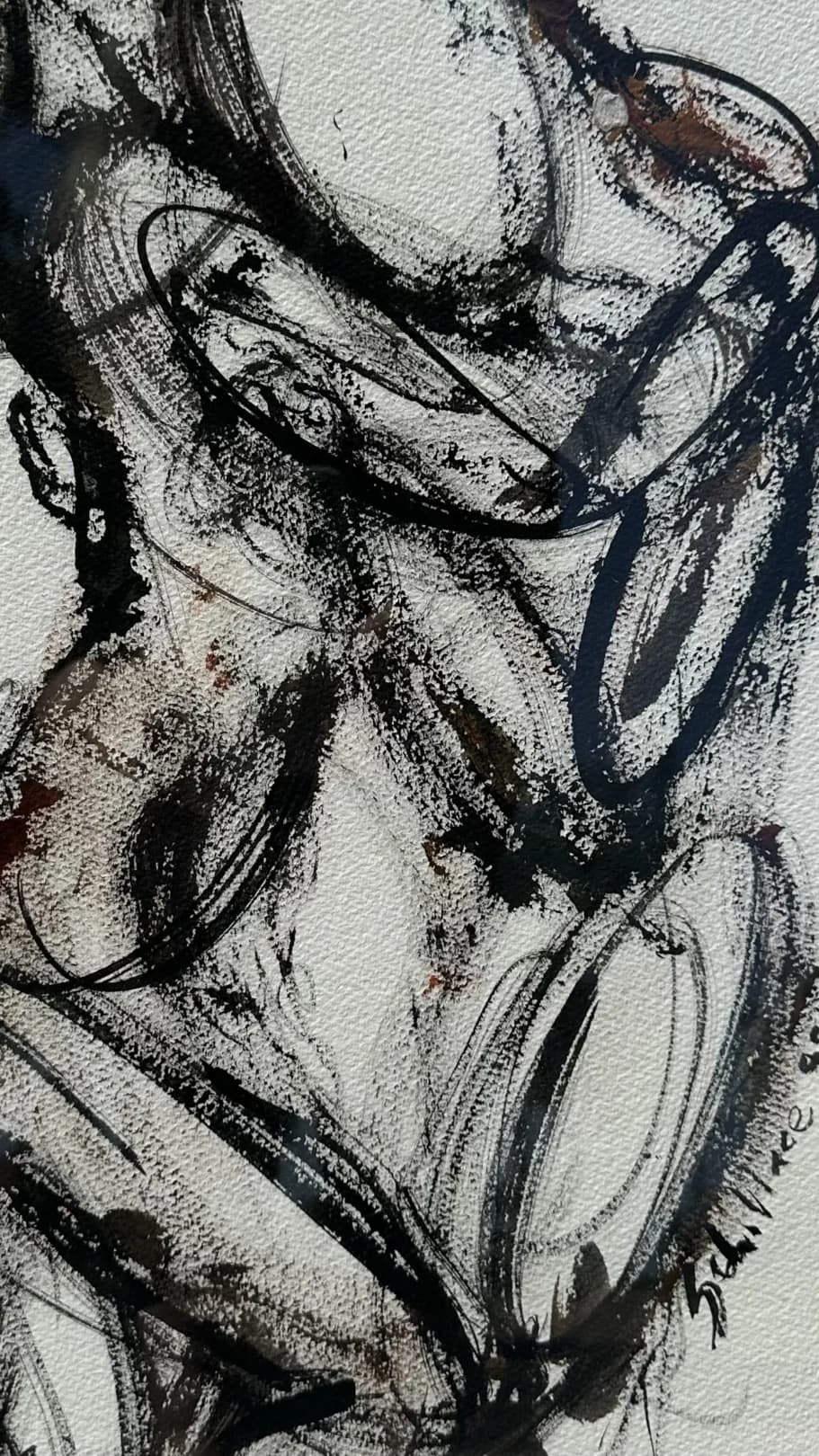
More Than the Eye Can SeeTwo Artists, a Father and Daughter, in Conversation Across Time
Perhaps the most significant thing about the conversation seen here is that it was not linear or consciously defined. It did not happen in any way Ellen Schillace could have anticipated.
Her father died when she was seventeen. Much of what documented his life and work was discovered years after his death, having been scattered or hidden from her view through complicated circumstances. His unconventional archive existed within his art, poems, letters, and papers; in the National Archives in Maryland; in other people’s homes; and in her own childhood home, which she was unable to enter for more than twenty years—almost until her mother’s death at the age of one hundred. What is strangely obvious in retrospect is that the conversation may already have been taking place before she knew it was happening.
For years, she made portraits. Although portraiture revealed her gift for drawing, she did not consider it the entirety of the creative process. She needed more—more room for her own thoughts, for uncertainty, contradiction, and flaw. She believed that the role of the artist was to make sense of the world in all its contradictions and dilemmas.
Her black-and-white images emerged from an economy of tools and time. Through them, she found what she then called her artistic voice. These works became central to her process long before she understood that she might already be in conversation with her father.
Along the way, some of his papers were returned to her by a dear cousin who had kept them in Cleveland. Among them was a brochure containing her father’s artist statement. He wrote that the purpose of a work of art was to “paint more than the eye can see.”
By the time she discovered his words, she had already created a substantial body of work grounded in that same belief.
Only later did she recognize that their conversation had already begun.
Full Bios
Marcus Alfred Schillace (1907–1966)
Marcus Alfred Schillace, who exhibited professionally as Mark A. Schillace, was an American painter, commercial artist, poet, linguist, and World War II veteran. Born on June 3, 1907, he was the son of Sicilian immigrants and grew up in western Pennsylvania. He attended the University of Pittsburgh and later studied painting at the Corcoran School of Art in Washington, D.C. He graduated from the Columbia Technical Institute and worked professionally in both commercial and fine art.
During World War II, Schillace served in the United States Army and was recruited into work associated with the Office of Strategic Services. His military qualification record identifies him as an interpreter and radio operator. Fluent in Italian, French, and Spanish, he translated written and spoken material, interviewed civilians and enemy personnel, taught languages to officers and enlisted men, and served in Africa and Italy for approximately seventeen months. As a radio operator, he transmitted, received, coded, and decoded messages, including enemy communications. His service took him through North Africa and wartime Italy, experiences that also entered his poetry and art.
After returning to the United States, Schillace lived and worked in Washington, D.C., and Providence, Rhode Island. He maintained a studio in Providence’s historic Arcade Building and produced watercolors, oils, drawings, portraits, landscapes, and commercial artwork. His exhibition record included one-person shows in Italy, Washington, D.C., New England, and Cleveland. A monthlong exhibition of his watercolors, oils, and drawings was held at the Art Display Studio in Providence in October 1956. In 1965, Strong’s Art Gallery in Cleveland presented another solo exhibition spanning several years of work. Contemporary newspaper coverage described his art as widely varied in subject and technique, with particular attention to landscape and portraiture.
Schillace also united poetry and visual art throughout his career. His poems appeared in two anthologies published by Crown Publishing Company, and his artwork entered public and private collections in the United States and abroad.
His surviving artist statement reveals the ideas at the center of his practice. He believed that what art leaves unsaid may be as important as what it makes explicit. Rather than reproduce a subject through detail alone, he sought its emotional content and inner perception. His aim was to simplify what he saw and to portray the world not only as it appeared, but as he had learned to see it creatively.
Schillace’s surviving paintings, drawings, poems, letters, military records, and exhibition materials reveal a life in which art, language, war, memory, and silence were inseparable. Although portions of his history remained hidden for decades, the fragments now being recovered establish him as a serious working artist, published poet, and gifted linguist whose creative life extended across continents—and whose artistic vision continues through the work of his daughter, artist Ellen Schillace.
Ellen Schillace
Ellenis Schillace is a Minnesota-based artist, curator, and arts advocate whose work explores memory, identity, loss, social consciousness, and the complicated ways personal and collective histories are carried forward.
Born in Washington, D.C., and raised in Providence, Rhode Island, Schillace grew up in a working-class Italian American family. Her father, Marcus Alfred Schillace, was an artist, poet, and World War II veteran who served with the Office of Strategic Services. He died when she was seventeen. His absence—and the gradual discovery, decades later, of his artwork, writings, letters, and wartime records—became an important thread running through her own artistic life.
Schillace attended Salve Regina College in Newport, Rhode Island, on scholarship, earning her degree in English and psychology. She later returned to Salve Regina University and completed a Graduate Certificate in Expressive and Creative Arts Leadership in 2011. Her professional life has included work as a medical social worker and more than three decades in real estate, alongside a sustained commitment to making art, organizing artists, curating exhibitions, and building opportunities for women in the arts.
Her artistic practice has evolved across more than five decades. Early portraiture was followed by an extensive body of distinctive black-and-white ink-and-brush work, and later by the Ancestors Series, Painting without Paint (collage work),Water Is Life, Upwelling, and Containment series. Across these bodies of work, Schillace has repeatedly returned to questions of memory, witnessing, human connection, silence, and what remains unknowable.
In 1983, she was among the founders of WAVE Gallery in St. Paul, Minnesota, an artist-built exhibition space created by women associated with the Women’s Art Registry of Minnesota. She has served on the WARM board, as President of the Minnesota Women’s Caucus for Art, and as Vice President of the International Association of Female Artists. Her curatorial work includes the 2016 Women and Money Project at the University of Minnesota’s Katherine E. Nash Gallery, which brought together twenty-nine artists to examine women’s relationships to money, value, power, and economic systems.
Schillace has received recognition for both her artistic and community work, including Salve Regina University’s Mission Award in 2007 and the Guild Association’s Angel Award in 2010.
In recent years, her work has increasingly engaged the relationship between personal history and historical evidence. Her artist book Reverie grew from decades of searching for and reconstructing the story of her father. Rather than attempting to resolve the gaps in that history, Schillace has become interested in the gaps themselves: the place where documentation ends, memory intervenes, and imagination makes relationships visible.
Her recent Containment series extends that inquiry through continuous, densely layered mark-making. Created during a period of profound personal and historical reckoning, the works function less as explanations than as containers—places capable of holding grief, contradiction, memory, uncertainty, and witness without demanding resolution.
Underlying Schillace’s work is a conviction inherited in part from her father, who wrote of painting “more than the eye can see.” Her own work continues that proposition. Knowledge may establish the fragments; imagination allows relationships among them to emerge.For Schillace, art does not necessarily provide answers. It bears witness, asks questions, and makes room for mystery.